Travel: Are Truffles Really Worth All The Fuss Made About Them?

———–

———–

ROBERT BONNELL, OUR CORRESPONDENT IN FRANCE, SAYS YES

Editor’s Note: Truffles, those little knobs of fungus, have long been a prized ingredient in French and Italian cooking, and in recent years have begun to appear on more and more high-end American restaurant menus. Are they really worth their high price and do they live up to all the hype?  Robert Bonnell takes us on a visit to a winter truffle market in France, and explains what the fuss is all about. And yes, you read the above photo correctly, those lovely little buggers will cost you 700 € (about $1,000) a kilogram. Robert reports:

The black truffle, tuber melanosporum, is a devilishly expensive fungus which lives underground, associated with the root systems of oaks and several other trees. In France, truffles are harvested from late November until early March and are considered a great delicacy, their unique taste and aroma making them an exalted addition to a variety of dishes.

Commonly associated with the more southerly French regions of Périgord and Provence, black truffles are also found in the southern Loire Valley. Some are still found wild in the woods, but many come from plantations of truffle oaks, grown from seedlings whose roots were infused with truffle spores. But even in the plantations, a truffle hunter needs help to find them. Once performed by pigs, locating truffles is now the work of dogs. (As one purveyor of truffles says, it’s not easy to talk a pig into getting into the car.) At any rate, an effective truffle-hunting dog at work is a wonder to behold.

Continue reading

It’s Winter: Time to Make Sauerkraut at Home (If I Can, So Can You!)

———–

———–

For years I hesitated to try making sauerkraut.  I guess I thought the process was too mysterious and difficult. Last year I tried making it for the first time and it came out wonderfully.  What I discovered was, it isn’t difficult at all. Basically, you chop cabbage, add salt, and let it sit.  In a couple of weeks, you have sauerkraut.  O.K., I exaggerate a bit, but truly, it is not complicated.

All right, I hear some of you wondering, “why would I even want to make sauerkraut at all?”  And if you’ve only eaten that mushy stuff out of a jar or can, I don’t blame you.  Take my word for it, fresh, homemade kraut is something else entirely. And nutritionally, it combines the great profile of cruciferous vegetables with the probiotic goodness of all naturally fermented foods. Vern Varona, in his book, Macrobiotics for Dummies, puts it this way: “Researchers have shown that the process of fermenting cabbage produces isothiocyanates, which are known to prevent cancer growth….Sauerkraut also has strong detoxifying properties. Containing plentiful amounts of probiotic bacteria, which create lactic acid, sauerkraut aids digestion by restoring a healthy balance of beneficial bacteria throughout the intestinal tract.” Not convinced? Once made, it’s a convenience food, as it will keep in your fridge for weeks, maybe months, no cooking or further preparation needed. True, it is salty, so think of it as a pickle or a condiment.  Eat it in small quantities, a couple tablespoons at a time. If you’re still worried about salt, give it a rinse. It’s great in sandwiches or as a condiment with rice and other grains. My easy, step-by-step directions are after the jump.

———–

Photos: Top--Cutting the red cabbage. Above--By the fifth day it's already looking like sauerkraut, although still crunchy and only lightly fermented.

———–

Continue reading

Fingers Crossed, But Apparently I’m Buying This House!

———–

It hasn’t entirely sunk in yet, but it seems I’m about to become a home owner. Judy, my realtor, called yesterday to tell me my offer on this 1045-square foot house built in 1932 has been accepted. After loosing out on two others, I was beginning to wonder if I’d ever find my house.  It seems that the houses I’m drawn to, a lot of other people like as well (there were six offers on this house). Still, at just over $100,000, and with interest rates as low as they are, it will be much less costly to buy than to continue to rent. So, knock on wood, if everything goes well, we are scheduled to close escrow on February 17th.

Like most things in life, this house has its upside and its down. The exterior could use sprucing up; the house needs a new roof, and the garage, roofless, is possibly a tear down. On the other hand, the interior is  freshly-painted and move-in ready. There are great hard word floors throughout, and the home’s original character is very much intact. Also, there’s a new foundation, and unusual for California, a walk-out basement. The kitchen, did I mention the kitchen?  It’s more than I need, but I’ll take it–beautifully remodeled with spacious granite-topped counters, prodigious Ikea storage, and sunny windows facing east and south. Interesting isn’t it, that the house which has by far the best kitchen of all the houses I’ve seen is the one I’m able to buy? Best of all is the location, location and location.  While it doesn’t have water views, it is on a hill near the marina and waterfront.  From my street, there are views of Mare Island, San Pablo Bay and the hills of Marin. With a little help from my friends, this could be the cosy-est and cutest house in all Vallejo!

What am I feeling?  Amazement and gratitude mostly, and once in a while a little bit of dread at the responsibilities of home ownership. With housing as expensive as it is in the Bay Area, I never thought I could be a home owner. Well into my sixties, this property virgin is about to be a virgin no more. And truthfully, I recognize that I’m not alone in this. To family members who stepped forward to help with the down payment, and to friends who offered advice, encouragement, who said prayers and lite candles, I say a sincere “thank you.” And because my kitchen is also my MacroChef laboratory, I hope to share with all of you what we create there for many years to come. Again I say, “thanks.”

Click here to see more photos of what will be, if all goes well, my new home. I previously posted about my home buying journey here.

Update: I’ve posted more photos that I took during the home inspection, after the jump.

The kitchen, all new and pristine with it's marble tile floor and granite counters, is a bit over the top for a house this modest. However, with tons of counter space and storage, I'm not complaining (need to change the hardware on those cupboards, though). Update: More photos, after the jump.

———–

Continue reading

Produce Superstars: Are Apples An Endangered Species?

———–

———–

Apples are one the oldest and most widely-grown of all plants cultivated by man, and to answer the question posed by my headline: no, apples as such are not endangered, but thousands of apple varieties most definitely are. One hundred years ago, as many as 15,000 varieties of apples were cultivated in the U.S., whereas today, eleven varieties make up 90% of all apples grown commercially. They’re the usual suspects: Fuji, Pink Lady, Red Delicious, Golden Delicious, Gala, Granny Smith, and so on. So, imagine my surprise when I saw these ping pong ball-sized heirloom beauties in the organic section of my local supermarket. Upon doing a little research, I discovered there are two feel-good stories here. One has to do with heirloom apples, the other with the farmers who grew them.

So, what are heirloom apples? You’ve probably seen, bought or possibly even grown heirloom tomatoes, old varieties which were once common, but which have almost disappeared. With apples, it’s the same idea: conserving old varieties keeps us in touch with our cultural history, safeguards genetic diversity, and provides us with a greater choice of tastes, textures, colors and culinary possibilities. Prominent among groups promoting heirloom apples is the Slow Food Movement which has published a wonderful booklet on the subject. In the Bay Area, Slow Food Russian River promotes Gravenstein apples in Sonoma County, where orchards have been declining for decades due to suburbanization and conversion to vineyards.

But, I digress. The crunchy, moist apples I bought are Crimson Gold, a variety developed in the 1940′s by crossing two other heirloom varieties, Yellow Newton and Esopus Spitzenburg, a crab apple. Crimson Golds had all but disappeared by the 1970′s, when they were rediscovered, and now they’re grown in small quantities in a half dozen commercial orchards. With a nice balance of sweet and tart, they are great for eating when you want a little snack, something less than a large apple. They’d be perfect to pack in lunch boxes or to carry in your pocket. I haven’t tried baking them, but, reportedly, they hold up well, maintaining good texture. I think you could simply pull off the stem and bake them whole.

The other feel good part of this story is that they are grown by a quality-conscious, family-owned business, Cuyama Orchards, in California’s Santa Barbara County. Howard and Jean Albano have been growing apples since the 1990′s on a farm 30 miles east of Santa Barbara. At 3,200 foot in elevation, their sixty acres of organic orchards produce well-known varieties such as Pink Lady, Fuji and Gala, but they’re also committed to growing heirloom varieties which they test market at Southern California farmer’s markets.  Recently, they’ve planted 200 trees each of heirloom apples from France and Turkey. Having grown up on a farm, I’m in touch with what a risky life it is, and so, I salute the Albano family for creating a thriving business and for helping to keep alive a part of our cultural heritage which could so easily be lost.

———–

———–

Caramelized Onion Corn Muffins (Eat’em While They’re Hot!)

————


————

Those of you who have been following this blog for a while may have noticed that I’m crazy about corn. I’m not entirely sure why, maybe it’s because I was reared on a southern Minnesota corn and soy bean farm and we depended upon that highly productive grain to put food on our table and money in the bank. In any case, today’s recipe showcases cornmeal, along with caramelized onions. True, caramelizing the onions takes a bit of time and patience, but you’ll be rewarded with an addition to the muffins which is moist, sweet and slightly smoky. You could, of course, bake this recipe in a cake pan as cornbread, but it seems to me muffins are more fun to eat, with extra crunchy, golden crust around the edges. Using cupcake papers to line your muffin pan will save you tons of grief at clean-up time and ensure that the muffins pop out easily. Cornbread in any form pairs well with soup, and especially with soup in which beans play a prominent role. Recipe, after the jump…

———–

Illustration: Corn with both male and female flowers from Köhler’s Medizinal-Pflanzen (via Wikipedia)

Continue reading

Make Ravioli At Home–Susanne Jensen Shows Us How

———–

———–

Editor’s Note: My friend Susanne Jensen is a natural foods chef who’s had a long and varied career, including having been both a student and teacher at the Kushi Institute in Massachusetts. Currently, she teaches cooking at Willard Middle School in Berkeley. She’s the one responsible for the delicious ravioli we enjoyed at my open house last week. In this guest post, she shares her insights into making ravioli– her recipes and step-by-step photos are after the jump.

———–

Making ravioli is something fairly new to me. It started a few years ago, when I had to find a fun and creative bean recipe for my middle school students. We had done bean soups, bean chili, bean burgers and beans for burritos, but needed a new recipe. I came upon White Bean Ravioli in Peter Berley’s book  Modern Vegetarian Kitchen. I purchased a few pasta makers and off we went on a bean ravioli adventure. The students made dough, bean filling, rolled out the dough, stuffed the dough with filling, cut and cooked. At the end we all sat down to a feast of bean ravioli. Even the most reluctant bean eater enjoyed these raviolis. At home I have now expanded the repertoire to squash ravioli, cheese ravioli (for my daughter, who loves cheese) and the  newest:  fish ravioli, which was invented this week inspired by a piece of left over fish and some left over squash.  There are really no limitations, other than the imagination, to the varieties of ravioli one can make.  Bon Appetit!

In the recipe for Gary’s New Years open house, I used butternut, carnival and red kuri squash. Any variety or mixtures of squash can be used for this recipe. I prefer the sweeter kinds. I cut the squash in half, removed the seeds and roasted the squash on a baking sheet, open side facing down, for about 35-40 minutes at 400˚F. Once the squash was soft, I scooped it out of the skin and blended it in a food processor.

————

————

Continue reading

Gathering to Celebrate a New Year With Friendship and Good Food

————

————
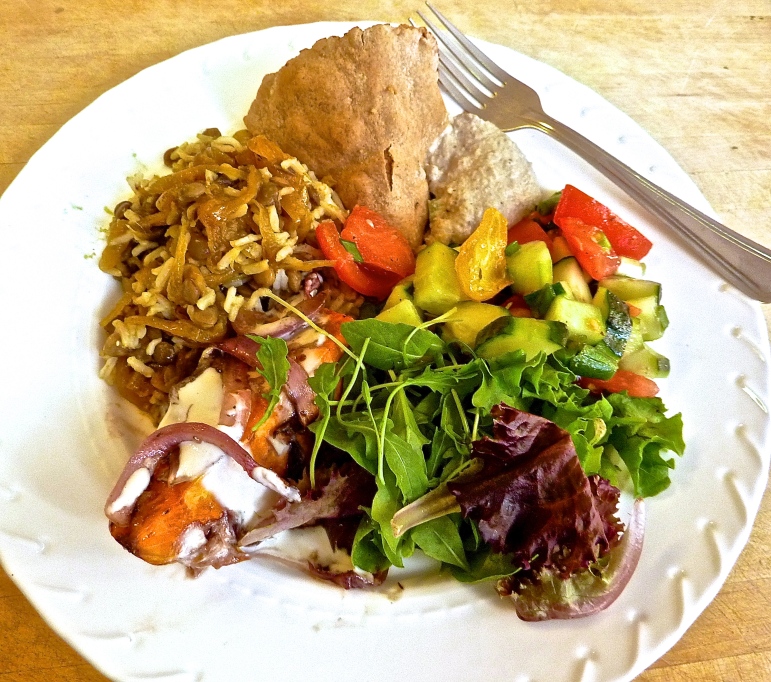
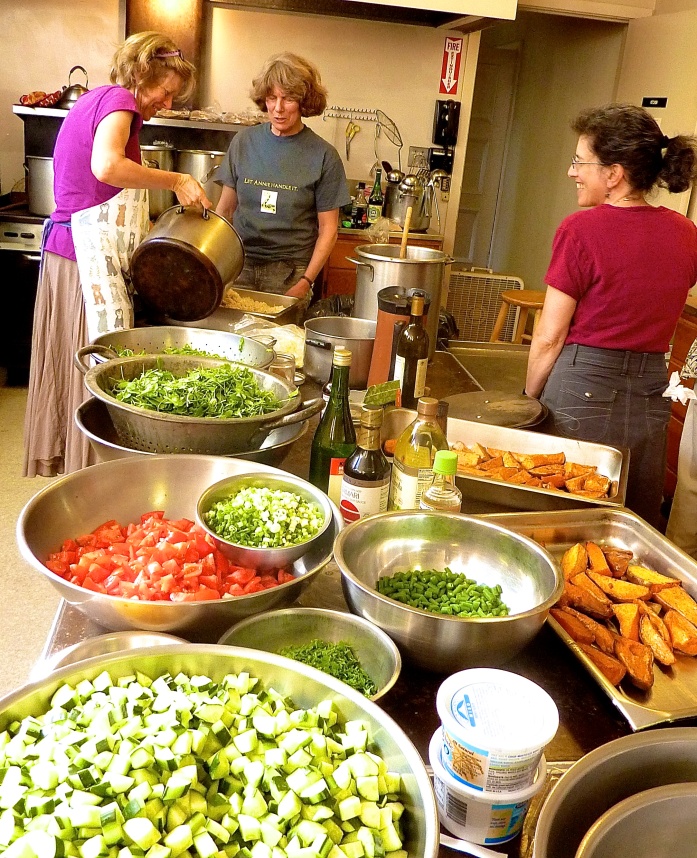
My friends in the Bay Area have been coming to my home on New Year’s Day for so long, we can scarcely remember a time before this tradition began. My modus operandi is that I try to keep it simple; I set out a buffet of six or seven dishes (plus bread and a dessert or two), most of which can be  prepared ahead and served at room temperature, and everyone helps themselves to food and beverages and then settles in wherever they can find room to enjoy a mellow afternoon of conversation. Sometimes my menus have a theme, and sometimes I just cook dishes I think will go together, and I try to challenge myself by making at least one thing I’ve never made before. This year, my friend Susanne Jensen offered to contribute homemade squash ravioli, and so I dreamt up a more-or-less Italian menu around that (I hope soon to put up a separate blog post on Susanne’s raviolis). So, here in words and photos are five dishes we made for this year’s celebration. For dessert I made the Italian fruit cake, panforte, which I previously posted here. All these dishes could not have been done without the help of my friend, the inimitable Frank Melanson. Frank came three days before the party to help with all aspects of preparation.

Top photo: If a classic summer salad consists of tomatoes, cucumber and lettuce, of what would you construct a winter salad? That’s the challenge I faced in creating this dish. I based this salad on vegetables (and some fruit) which, in the Bay Area, are plentiful in farmer’s markets now. The major ingredient is savoy cabbage which we tore into pieces as you would lettuce, then blanched very briefly.  Once drained and cooled, we tossed in radicchio and belgium endive, as well as some fuyu persimmon slices and pomegranate, and some toasted walnut pieces which we lightly-glazed with maple syrup. While for everyday meals I seldom combine vegetables and fruits this way, for this holiday meal I wanted to create an especially colorful and seasonal salad. To dress the salad, I made a creamy vinaigrette dressing in the blender, with apple juice concentrate, lemon juice, umeboshi vinegar, garlic, mustard, salt and pepper and olive oil.

Photo below: Cannellini beans, are not only so Italian, but are also one of my favorites. When cooked just right, they’re rich and tender, and almost meaty. I soaked the beans overnight and then cooked them for about an hour, but I started checking them for doneness after 50 minutes. Cook beans in plenty of water, then the only real trick is in the timing: check them frequently towards the end of the cooking time. Overcooked beans turn mushy, o.k. for soup, but a no, no for salad, and undercooked beans just don’t taste right and can be difficult to digest. Once cooked and drained, I tossed them with a dressing of olive oil, lemon juice, white balsamic vinegar, umeboshi vinegar, garlic and parsley. Just before serving, I mixed marinated kale into the beans, and that recipe is here. Kumquats chopped small added an occasional textural and flavor surprise. See three more dishes we made for New Year’s Day, after the jump…

———–

Continue reading

Travel: Notes From A Foodie Weekend in Portland

———–

———–

It’s not exactly a secret that Portland, Oregon has become one of America’s premiere food cities, known as it is for its fresh, local, seasonal, and largely organic cuisine. So, when I made a quick pre-Christmas trip there to visit my fellow foodie friend, Adele, I knew I was in store for some wonderful eating.  I was not disappointed. I was barely off the plane when Adele whisked me to Tan Tan, a friendly, family-run Vietnamese joint in the close-in western suburb of Beaverton. This is an easy-to-love restaurant, serving really fresh food, casual and inexpensive.  Reviewers on Yelp rave about the bahn mi sandwiches, but I found the more unusual Vietnamese crepe to be completely satisfying, and not to forget the spring roll. Most spring rolls don’t get me excited, but this vegan version, stuffed with seitan, tofu, and the usual rice noodles and veggies, delivered so much clean flavor you really didn’t even need to dip it in the rich peanut sauce. Pho, the much loved Vietnamese noodle soup, is  another specialty here.

Several factors have contributed to Portland’s rise as a food city. The relatively mild climate and proximity to the fertile Willamette and Hood River vallies would be two, but also there is Portland’s comparatively low cost of living which has attracted young chefs, because the cost of opening a food business is a fraction of what it would be in Manhattan, San Francisco or most big cities. Diners benefit as well, as prices nearly everywhere seem to be downright reasonable compared to the Bay Area (and Oregonians love to rub in the fact that there’s no sales tax). It would take a couple weeks of eating and food shopping in and around Portland to even skim the surface of its food culture, but in a few days, I was able to squeeze in quite a bit.  My report is after the jump.

———–

Vegan spring rolls at Tan Tan, with a luscious peanut dipping sauce.

Photos: From the top–1) Vietnamese Crepe with dipping sauce at Tan Tan in Beaverton, 2) Food carts in the S.W. Alder area of downtown Portland, and click on this video for a humorous, but informative report on Portland’s food cart scene. , 3) Retail store at Bob’s Red Mill, 4) Vegetarian Spring roll at Tan Tan contained both seitan and tofu, really yummy!

———–

Continue reading

Elegant and Easy-To-Make, Panforte Is Perfect For Your New Year’s Buffet

———–

———–

Panforte, literally “strong bread” in Italian, originated in Sienna in the middle ages as a sort of tribute paid to the monks and nuns, or so the story goes. In any case, it’s now a rich, fruit and nut cake made for the holidays and enjoyed all over Italy and a good many other places as well. High end stores sell panforte at steep prices, but you can easily make it at home. This maple syrup-sweetened version goes together quickly and bakes in only about 35 minutes. Serve with coffee or tea.

———-

Continue reading

Travel: Celebrating Winter Solstice Downtown (Where All The Lights Are Bright)

———–

———–

I’m not entirely sure why, but this is my favorite time of year. Perhaps it’s a holdover from childhood, when year’s end meant two weeks off from school, and of relative freedom.  But I do think it’s deeper  than that. It has to do, I think, with the change of season, with the solstice, when the nights are longest and hours of sunlight the fewest. Because the sun is lower in the sky, colors are more vivid, and everything feels lighter and less tense. It’s the time of the big yin, a time to turn inward, a time for less action and more contemplation. Our bodies, whether we acknowledge it or not, are attuned to these changes. For many plants and animals, winter is a time of rest, and shouldn’t it also be for us? I wonder if some of the extra illness so many of us experience in winter isn’t partly because we fail to heed this seasonal call to rest, and instead press ahead with ever more work and social activity.

Having said that, it’s also true that there’s a great deal to enjoy now. As the weather turns colder, people seem to gather more closely, and the bustle of cities becomes more alluring. I’m not much of a shopper, but once a year or so I enjoy the crowds in downtown San Francisco, which at this time reach an almost New York-like intensity. I agreed to meet up with my friends Susanne Jensen and Sophia Hummell to take in the music, the decorations, to people watch and to have a pre-Christmas lunch. Although it was the Winter Solstice and only four days before Christmas, with temperatures in the 60′s, and a bright sun, the crowds seemed both larger and more relaxed than usual. It felt as if we’d all taken a pledge to be in a really good mood. And so, here’s a little bit of what I saw, on my own, and with Susanne and Sophia on the shortest day of year. Whether or not you observe a holiday this week, I hope you are able to slow down, take a breath, and enjoy this special time of the year. Best wishes in all you do.

———–

Photos: Top–The world’s largest gingerbread house? Who knows, but you can walk through this edible marvel in the lobby of the Fairmont Hotel, on Mason Street at the top of Nob Hill. Occasionally, the story goes, people nibble on it and the hotel pastry chefs must make repairs.  Above: A Christmas tree and menorah side-by-side in Union Square. We were dismayed that neither this tree nor any of the the other trees we saw was real.

Panettone, the traditional Italian Christmas cake, stacked nearly to the ceiling at Molinari's, on Columbus Avenue in North Beach.

Continue reading

Follow

Get every new post delivered to your Inbox.

Join 227 other followers